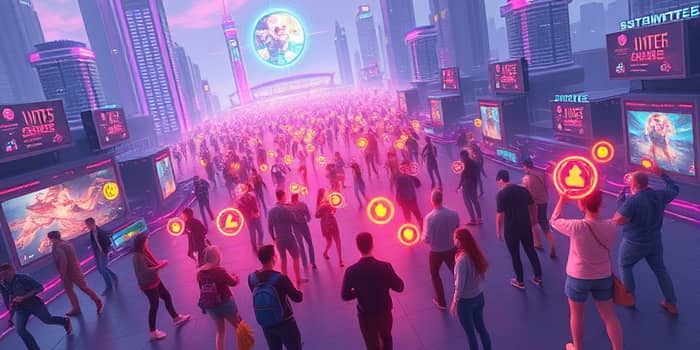
Web3 gaming has emerged as a transformative force, blending technology, economics, and community in unprecedented ways. As digital landscapes evolve, players and developers alike are discovering new opportunities to create, earn, and interact within decentralized worlds.
From tokenized assets to immersive virtual realities, this movement is redefining entertainment and digital ownership. In this article, we unpack the market dynamics, key segments, and practical strategies for thriving in the Web3 gaming ecosystem.
The Web3 gaming sector is experiencing rapid expansion driven by blockchain integration, with multiple forecasts pointing to sustained growth. Understanding these figures can guide strategic decisions for investors, developers, and gamers.
Discrepancies among sources often stem from different definitions—Web3 gaming versus blockchain gaming—and varied baseline years. Nonetheless, consensus points to a horizon of robust investment and widespread adoption.
To navigate this complex realm, it helps to break down the market by game model, underlying technology, device, and user type. Each dimension presents unique opportunities and challenges.
By understanding where your interests and strengths lie—be it in P2E, hybrid mechanics, or protocol development—you can position yourself for maximum impact.
Device choice shapes user experience, engagement levels, and entry barriers. Mobile, PC, and emerging VR/AR platforms each offer distinct advantages.
With mobile penetration surging, entry-level experiences attract casual gamers. Hardcore enthusiasts often gravitate toward PCs or VR for deeper immersion.
Geography plays a pivotal role in adoption rates and market size. Two regions are at the forefront of Web3 gaming innovation and growth.
North America held a commanding 61.7% share in 2024, driven by venture capital, robust infrastructure, and mainstream crypto adoption in the U.S. Major studios and startups alike are deploying ambitious blockchain-based titles.
Asia Pacific is the fastest-growing market, with a projected CAGR of 21.27% through 2033. Mobile-first economies in India, Southeast Asia, and strong regulatory support in South Korea and Japan fuel rapid P2E uptake.
Several trends are propelling this revolution:
Integration with VR/AR further enhances immersion, while hybrid models address sustainability concerns and token fatigue by balancing traditional subscriptions and tokenized incentives.
Despite the excitement, the Web3 gaming landscape faces hurdles:
Scalability and transaction costs remain acute challenges, prompting many projects to explore Layer-2 solutions like Polygon and BNB Chain.
Regulatory uncertainty and environmental debates around proof-of-work networks highlight the need for green protocols and clear compliance frameworks.
Maintaining long-term engagement demands innovative game design, economic stability, and robust governance models to prevent token inflation and ensure fairness.
Whether you’re a player, developer, or investor, these actionable guidelines will help you thrive:
For developers, prioritize seamless wallet integration, UX simplicity, and cross-chain compatibility to attract wider audiences. Investors should assess tokenomics, team credibility, and ecosystem partnerships before committing capital.
The rise of Web3 gaming represents more than a trend—it is an ecosystem shift that rewards creativity, community, and entrepreneurship. By leveraging play-to-earn opportunities and understanding core mechanics, you can actively shape this digital frontier.
As technology evolves toward greater interoperability, sustainability, and immersion, early adopters stand to benefit from unprecedented ownership models and revenue streams. The time to engage is now—join the movement, build with purpose, and level up in the next generation of gaming.
References