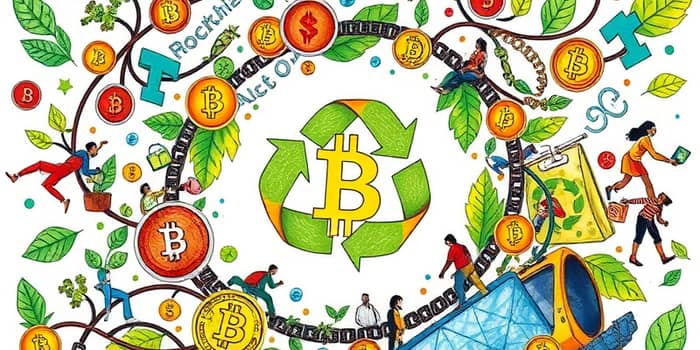
Our planet and our financial systems both face crises of waste and inefficiency. As climate change accelerates and global debt reaches unprecedented levels, we search for solutions that heal ecosystems and empower individuals. At this crossroads emerges the concept of a crypto-powered circular economy, where every token, transaction, and action feeds back into a regenerative loop of value. By combining blockchain transparency and meritocratic markets, we unlock an opportunity to redefine wealth and stewardship.
In traditional industries, resources flow linearly: from extraction to consumption to disposal. A circular economy aims instead to retain and repurpose materials at their highest utility, minimizing pollution and creating sustainable growth. Applying this to digital value, we treat obsolete fiat currency and opaque financial intermediaries as "waste," replacing them with decentralized tokens that remain in constant circulation, fueling communities and businesses alike.
Through imaginative applications—from plastic recycling to energy credits—blockchain networks incentivize positive behaviors, ensuring that value never leaves the system. This article explores how pioneering projects and cutting-edge technologies can merge to build a truly circular digital economy, inspiring action at every level of society.
A circular economy rethinks production cycles by prioritizing reuse, remanufacture, and recycling, all while promoting natural regeneration. When extended to finance, it shifts money from a store of lost value into an active, regenerative force. Cryptocurrencies like Bitcoin and Ethereum become the lifeblood of this new model—immutable, transparent, and programmable.
Unlike fiat money subject to inflation and state interference, decentralized digital currencies empower peer-to-peer value exchanges without intermediaries. Markets evolve organically, guided solely by supply and demand dynamics rather than arbitrary regulation or centralized planning. This meritocratic approach elevates effort and contribution over privilege and permission.
Key features of crypto circular economies include:
Community governance structures, often implemented as DAOs, ensure that stakeholders collectively decide on protocol parameters and reward distributions. This democratic layer safeguards against centralized capture, aligning incentives with local needs.
From Bitcoin-only towns to global platforms where freelance professionals accept payments in crypto, these experiments showcase how monetary innovation can catalyze sustainable local economies. By decoupling financial activity from extractive practices, participants focus on adding genuine value to the network and the planet.
Tracking physical assets on a distributed ledger creates accountability across supply chains. When materials are tagged with digital tokens or NFTs, every handoff becomes visible and verifiable. This transparency not only reduces fraud but also ensures that items are directed to the most appropriate reuse or recycling channels.
Imagine depositing a plastic bottle in a solar-powered reverse vending machine. The machine scans a QR code, communicates with a blockchain, and instantly issues tokens to your digital wallet. You redeem these tokens for groceries at your local market, while recycling firms use the same tokens to purchase sorted waste, creating sustainable digital infrastructure for generations.
Beyond plastics, several initiatives track electronic waste, textile fibers, and organic compost. By standardizing data capture through IoT sensors and smart contracts, blockchain ensures that valuable materials return to manufacturing loops instead of languishing in landfills.
Governments and NGOs are beginning to recognize the potential of these models. Collaborative pilot programs can blend public resources with private innovation, demonstrating that policy frameworks can adapt to support sustainable digital infrastructure for generations.
Designing robust tokenomics is critical to sustaining a circular crypto ecosystem. Tokens must reflect the real-world value of the behavior they incentivize, whether that is collecting recyclables, conserving water, or generating renewable energy. When smart contracts release rewards automatically, participants trust the system without middlemen or manual verification.
Liquidity management mechanisms such as bonding curves and automated market makers help maintain token stability, ensuring participants trust that tokens hold real value. By dynamically adjusting supply based on participation metrics, these protocols prevent extreme volatility that could disrupt circular flows.
Advanced models layer additional mechanisms: Extended Producer Responsibility fees are pre-funded to cover end-of-life management, while Carbon Fee & Dividend frameworks return value to those holding tokens in closed loops. Gamification elements such as leaderboards and badges further boost engagement, creating community-driven momentum.
Adopting a crypto-based circular economy unlocks profound benefits across environmental, social, and economic dimensions. Studies show that a modest 1% increase in blockchain utilization can drive a 0.341% rise in recycling and remanufacturing rates, translating to millions of tons of diverted waste.
Moreover, circular crypto systems can boost community well-being. Shared projects foster social cohesion and a sense of purpose, translating into improved mental health and stronger local networks. As participants see tangible returns—both material and social—the narrative shifts from extraction to regeneration.
Consider a coastal village partnering with the ReSea Project: locals collect plastic debris on the shoreline, upload data via a mobile app, and receive tokens redeemable for essential goods. This approach not only funds community needs, but also fosters a culture of stewardship and intergenerational learning.
By transforming waste into rewards and aligning incentives with sustainable outcomes, these systems demonstrate how incentives that drive sustainable behavior can scale—from small towns to global trade networks.
Emerging technologies will amplify the impact of circular crypto economies. IoT devices equipped with GPS and RFID tags automate data collection, while AI-driven analytics optimize routing and processing strategies. Public and permissioned blockchains collaborate via interoperable protocols, ensuring seamless data exchange without sacrificing privacy.
Privacy-preserving techniques such as zero-knowledge proofs allow verification of compliance without exposing sensitive commercial data. Layer-2 networks reduce transaction fees, making micro-rewards viable for everyday actions like swiping a reusable cup or turning in a smartphone battery.
Digital identity solutions, from decentralized identifiers (DIDs) to verifiable credentials, enable individuals to prove eligibility for rewards while maintaining privacy. This approach balances regulatory compliance with inclusivity, ensuring no community is left behind.
Looking ahead, we anticipate:
- Digital twins of physical assets linked to real-time environmental indicators
- DAO-governed resource pools allocating capital to high-impact circular projects
- Integration of ESG reporting into DeFi dashboards, unlocking institutional funding
The fusion of these innovations heralds a future where money itself becomes the mechanism for regeneration rather than depletion. As communities, businesses, and governments embrace these models, we inch closer to a world where every economic decision enriches both people and planet.
Now is the time to pioneer circular crypto economies in our own neighborhoods. Whether by launching a tokenized recycling initiative, joining a DAO focused on sustainability, or simply advocating for decentralized finance solutions, each action contributes to a larger movement. Let us come together to harness blockchain’s promise and build a world where economic prosperity and ecological stewardship walk hand in hand.
References