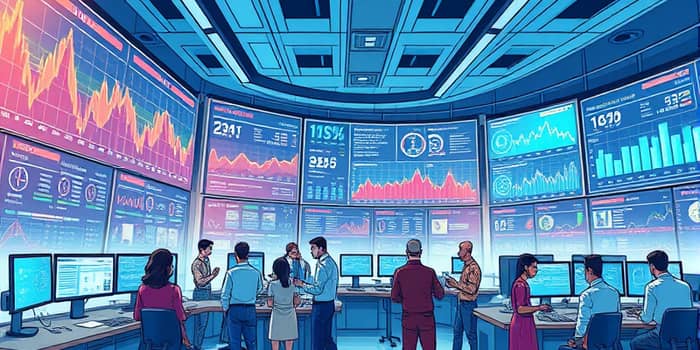
In an era of unprecedented market volatility and evolving cyber threats, financial institutions must adopt strategies that provide continuous oversight and immediate responses to emerging risks. Real-time risk management transforms traditional, manual processes into a platform for dynamic protection and informed decision-making. This powerful approach equips banks, brokerages, and clearing firms with the ability to anticipate threats and safeguard assets before they escalate into costly disruptions.
Financial risk management has long focused on identifying, assessing, and addressing threats to assets, cash flow, and institutional viability. In fast-paced markets, lingering on nightly reports or manual reviews can mean the difference between strategic gain and catastrophic loss. By leveraging instantaneous monitoring, assessment, and mitigation, organizations gain a continuous overview of exposures, trends, and breaches. This paradigm shift from reactive to proactive safeguards ensures that objectives remain on track even amid sudden price swings or operational anomalies.
At its core, real-time risk management delivers data-driven event-triggered systems for current views across diverse asset classes. Whether tracking derivatives, futures, or complex options positions, institutions obtain immediate insight into margin requirements, counterparty exposures, and capital allocations. The result is a resilient framework that minimizes potential losses while maintaining strategic flexibility.
Enabling real-time risk management requires a robust technological ecosystem designed for high-throughput data processing and rapid computation. Event-driven architectures can handle upwards of 10,000 market data messages per second, triggering portfolio revaluations and margin recalculations on the fly. Core components include a PortfolioRiskCalculator, a MarketDataListener, and scalable streaming platforms that integrate trading activity and pricing feeds.
This infrastructure supports re-aggregation cycles of as little as 5, 20, or 60 minutes, ensuring near-continuous alignment of risk metrics. Combined with real-time reporting and breach notifications, stakeholders receive instant alerts when exposures exceed thresholds or when unusual account activity occurs. Such agility transforms risk oversight from a periodic review into an ongoing, intelligence-driven activity.
Adopting real-time risk frameworks requires a tailored approach that reflects each institution’s size, trading volume, and regulatory obligations. Clearing firms, brokerages, and banks often blend human expertise—such as intelligence-driven manned guarding—with automated controls in the cloud. Embracing the shared responsibility model and least-privilege access ensures that data integrity and confidentiality remain top priorities.
Automating vulnerability assessments and software updates further hardens the environment. By integrating risk management tools within existing operations, institutions foster a holistic risk management in real time culture. Cross-functional teams collaborate via unified dashboards, ensuring that finance, IT, and security divisions share a consistent risk language and actionable metrics.
Organizations that embrace real-time risk management reap significant advantages. They gain optimized capital allocation for long-term stability, shifting focus from short-term gains to sustainable value creation. Instant transparency into exposures and margins allows operations teams to reallocate resources swiftly when conditions change.
Despite its transformative potential, real-time risk management demands vigilant attention to data quality and system reliability. Institutions must secure continuous data feeds, minimize latency, and maintain resilience against outages. Evolving cyber threats and regulatory changes further require frequent updates to controls and processes.
Global operations introduce complexities such as cross-jurisdictional compliance and diverse infrastructure standards. Achieving true real-time visibility means investing in robust networks, scalable compute resources, and dedicated monitoring teams that can adjust thresholds and workflows in response to new developments.
As markets and threats evolve, so too must the safeguards that protect institutions and their clients. By committing to ongoing refinement, continuous training, and integrated technology, organizations can build an enduring defense strategy that turns uncertainty into opportunity.
In a world defined by rapid change, real-time risk management stands as a proactive bulwark—ensuring that financial institutions remain resilient, agile, and ready to protect value under any circumstance.
References