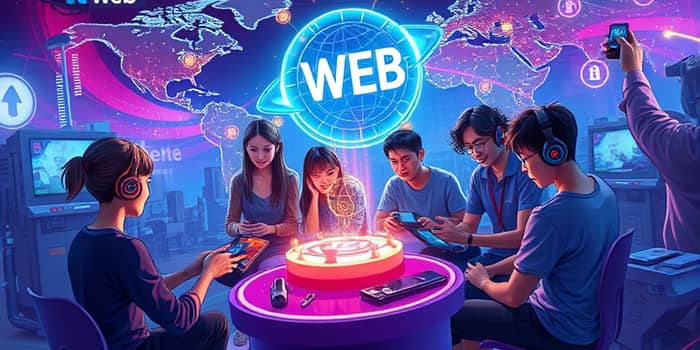
In an era where traditional gaming and blockchain technology converge, play-to-earn guilds are redefining how players access, engage with, and profit from Web3 games. By pooling resources, expertise, and digital assets, these collectives are breaking down the high barriers that once kept many gamers on the sidelines.
This article explores the mechanics, market dynamics, real-world examples, and future of P2E guilds, offering practical insights for players, investors, and developers alike.
At their core, play-to-earn guilds function as decentralized communities that pool capital, in-game items, and NFTs to empower participants who lack the upfront funds to enter lucrative blockchain games. Operating often as DAOs (decentralized autonomous organizations), these guilds issue governance tokens, enabling members to propose and vote on asset acquisitions and strategic direction.
Guilds implement a revenue-sharing model based on measurable contributions—playtime logged, achievements unlocked, or assets supplied—ensuring every collaborator earns a fair share of proceeds. This setup transforms individual players and backers into symbiotic partners, aligning incentives and fostering communal growth.
Despite a 4.4% decline in daily active wallets during Q3 2025, blockchain gaming revenue rebounded to an average of $4.2 million per day in Q1 2026, marking a 12.5% year-on-year increase driven by higher ARPU. Play-to-earn titles command approximately 62% of total blockchain gaming revenue, and the P2E NFT segment is projected to grow from $1.11 billion in 2025 to $7.83 billion by 2034 (CAGR 24.3%).
Mobile platforms dominate, accounting for 55.2–73% of P2E activity, with Asia-Pacific representing 28.7% of the global market. Tokenized asset sales generate 42% of gaming revenues, while secondary marketplaces capture 68% of trade volume. Notably, guild asset leasing comprises 18% of transactions, and players show 25% greater willingness to purchase assets they truly own.
In broader context, global mobile in-app purchases reached $150 billion in 2024 (+13% YoY), while PC gaming revenues stood at $43.2 billion. Crypto gaming overall has surged 400% since 2024, with 70% of P2E engagement on mobile devices. A striking 32% of guild participants earn over $100 per month, and professional managers can command between $1,500 and $5,000 monthly.
By alleviating the initial asset requirements that once barred entry, guilds democratize access for novices in developing economies and seasoned gamers alike. Central to this democratization are several innovations:
These mechanisms cultivate sustainable ecosystems where developers benefit from a 60% increase in stable revenue, and players gain genuine digital ownership. The shift from P2E to play-to-own (P2O) further cements long-term engagement: retention rates in P2O titles can climb from 40% to as high as 87%, with overall engagement up by 30%.
As of 2026, structured guilds host 60% of serious Web3 players. Below is a snapshot of the most influential organizations and their models:
A striking example is a 50-player squad in Champions Arena on Polygon. With a startup cost of $750 per player, the guild generated an average of $1,800 per player per month over six months, peaking at $3,200 for top performers. Post-revenue splits, the guild netted $45,000 monthly while boasting an 87% retention rate.
While momentum builds, the sector faces hurdles. Short-lived speculation led to wallet churn, and scaling transparent governance remains complex. Additionally, market saturation in popular titles can compress earnings.
Looking ahead, open-source guild protocols and cross-guild alliances promise to deepen integration with mainstream esports and entertainment. Non-gaming applications—like tokenizing real-world assets—could leverage the same frameworks that democratized play-to-earn. Ultimately, by championing skill over speculation and community over isolation, P2E guilds are pioneering a new paradigm of digital cooperation and opportunity.
Whether you are a prospective player, an investor seeking high-growth ventures, or a developer exploring sustainable engagement models, understanding and participating in play-to-earn guilds can unlock unprecedented possibilities in the Web3 era.
References