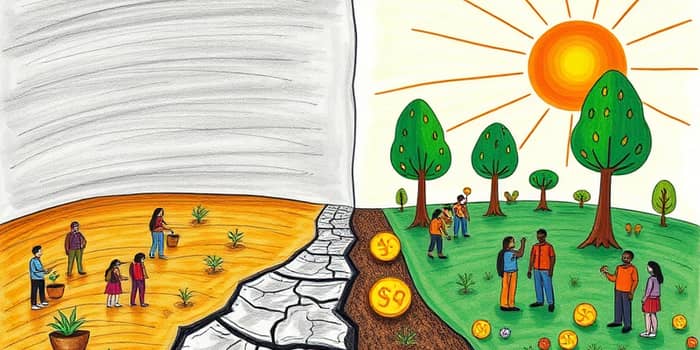
Many individuals, organizations, and nations feel trapped by limited resources and reactive decisions. This article charts a bold journey from a scarcity mindset to lasting security.
Scarcity is more than a lack of money—it is a pervasive belief that resources are inherently limited. When this mindset dominates, fear and short-term thinking take hold, leading to suboptimal choices.
Security, by contrast, restores agency, empowers strategic planning, and fosters shared prosperity. As Amartya Sen reminds us, true development hinges on freedom: the freedom to learn, work, and flourish.
Shifting from scarcity to security begins with awareness of fear-driven patterns. Recognize reactive habits—impulse spending, avoidance of risk, and overreliance on external support—and replace them with intentional practices.
Through these steps, you can transform your perspective on abundance and cultivate a resilient outlook.
Practical tactics turn newfound beliefs into tangible progress. The following table outlines key strategies, numerical targets, and supporting tactics to move from debt and uncertainty toward stability and growth.
These steps, when combined, help you overcome debt burdens with confidence and build lasting resilience and dignity in your finances.
Organizations operating under scarcity can harness constraints for innovation. By applying a decision matrix that balances urgency, values, and resources, leaders can phase initiatives and unlock growth.
For example, Mastercard’s initiative to onboard 500 million unbanked individuals by 2025 leverages partnerships, mobile platforms, and local networks—demonstrating how strategic and outcome-focused investments drive impact in scarce environments.
Meeting the Sustainable Development Goals requires an estimated $2.4 trillion by 2030. Public and private actors must collaborate on concessional aid, debt relief, and policy reforms to bridge this gap.
Local leadership, mission coalitions, and retooled multilateral banks are essential to shared global prosperity through local action. Yet challenges like climate shocks, migration, and pandemics demand resilient financing structures and adaptive governance.
Clear metrics guide transformation. Currently, two-thirds of the world’s extreme poor reside in fragile or conflict-affected states. Official development assistance hovers around 0.3% of global income—far short of the 0.7% target.
On the personal level, consistently saving 10% of income and maintaining three to six months of expenses as a buffer illustrate how small contributions compound exponentially over decades, fostering security and growth.
Beyond Mastercard, development finance institutions are reorienting toward mission-driven outcomes. A recent SEC roadmap shows individuals with structured debt-reduction plans improve credit scores by 30% in 18 months.
At the community level, cooperatives in Southeast Asia unified remittance networks, boosting collective savings by 25% and funding local infrastructure—proof that aligning incentives with purpose yields powerful results.
The journey from scarcity to security is both personal and collective. It begins with a mindset shift, followed by deliberate strategies and data-driven decisions.
Embrace financial planning, invest in resilience, and advocate for reforms that elevate communities. Together, we can reimagine finance as a tool for dignity, opportunity, and shared prosperity.
Let this path inspire you to act today—turn constraints into catalysts, and join the movement toward a secure, flourishing future.
References