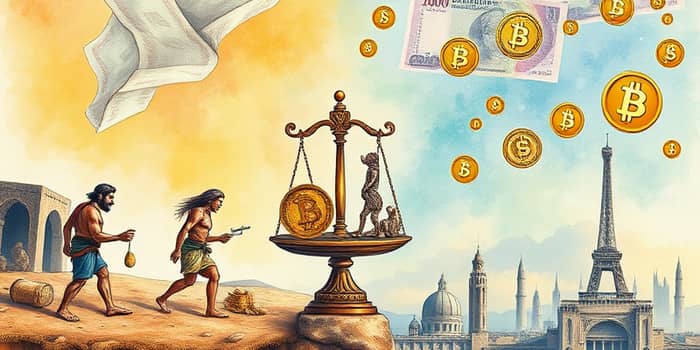
Currency has been at the heart of human progress, serving as a bridge between cultures, economies, and eras. From the earliest barter exchanges to the digitized ledgers of today, money has evolved in form and function. In this article, we trace its remarkable journey, revealing how each transformation reflects our collective ingenuity and resilience.
Long before coins or notes, humans relied on direct exchanges to meet their needs. The barter system, emerging around 6000 BC, allowed Mesopotamian tribes and Phoenicians to trade staples like tea, salt, weapons, and food. In colonial America, settlers bartered pelts, crops, and muskets, exemplifying the public trust and acceptance essential for any exchange.
As societies grew more complex, so did the need for standardized measures. Around 2150 BC, Mesopotamia introduced the shekel, tying value to a weight of barley. By 1000 BC, precious metal coins took shape, and by 700 BC, Lydia minted the first modern coins from electrum, a silver-gold alloy. These innovations laid the groundwork for more fluid and widespread trade networks.
Over the centuries, gold and silver became the cornerstones of wealth. Rulers minted coins stamped with their insignia, ensuring consistency in weight and purity. This era fostered the rise of empires, from the Roman denarius to Byzantine solidus. Metal money provided a reliable store of value, but its physical weight and vulnerability to theft posed challenges for long-distance trade.
The late 18th century saw formalized standards emerge. In 1816, England adopted the gold standard, limiting currency issuance to gold reserves. The United States followed suit with the 1900 Gold Standard Act. These policies embodied intrinsic value only through government decree, anchoring faith in national currencies.
Technological necessity spurred another breakthrough. During the Tang Dynasty (618–907 CE), merchants introduced promissory notes and certificates of deposit to avoid hauling heavy copper coins. By the Song Dynasty (960–1279 CE), the Chinese government had issued the world’s first official paper money. However, war and economic pressures led to depreciation, and paper currency vanished by 1455.
Europeans rediscovered paper money in the late medieval period, but it took centuries to gain widespread acceptance. During the American Revolution and the Civil War, the United States experimented with continental currency and greenbacks, foreshadowing the shift from commodity-backed money to government-issued notes.
In 1944, the Bretton Woods Agreement tied major currencies to the U.S. dollar, which in turn was pegged to gold at $35 per ounce. This arrangement fostered global trade and stability but eventually collapsed under mounting economic pressures. In 1971, President Richard Nixon suspended the dollar’s convertibility to gold, a decision that marked the pivotal turning point in history of modern finance.
Fiat currency—derived from the Latin term meaning “let it be done”—carries no intrinsic value. Instead, its power rests on full faith and credit of governments and the collective belief of the public. China first embraced fiat notes around 1000 AD, but fully fiat systems emerged globally only after 1971. From Continentals during the American Revolution to hyperinflationary assignats in France, paper money has been both a tool and a cautionary tale.
Today, most nations issue fiat currencies managed by central banks. These institutions wield tools like interest rate adjustments and quantitative easing to steer economies. Monetary policy has gained unprecedented flexibility, enabling rapid responses to crises such as the 2008 financial meltdown and the 2020 pandemic recession.
Currencies thrive when certain conditions are met. Central banks, governments, and the public each play vital roles in sustaining a fiat system.
In the digital age, technology continues to reshape how we conceive of money. Cryptocurrencies, powered by blockchain, promise decentralized networks free from centralized control. Meanwhile, central bank digital currencies (CBDCs) are under exploration, blending government backing with digital efficiency.
The ongoing evolution exhibits a persistent historical pattern exists where advancement in technology leads to fresh monetary innovation. From secure banknotes to tamper-proof polymer bills, and now to smart contracts, each leap has addressed enduring challenges like counterfeiting and accessibility.
As we step into the future, money may transcend physical form altogether, becoming lines of code, universally accessible and programmable. This vision demands collaboration across disciplines, robust cybersecurity, and an informed public willing to embrace change.
Ultimately, the story of currency is one of human creativity meeting necessity. By understanding its past, we are better equipped to shape a monetary future that is inclusive, resilient, and attuned to the needs of a global society.
References