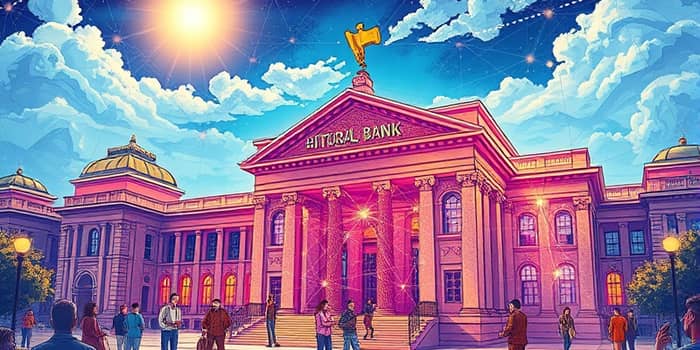
The story of finance is a journey across centuries, fueled by innovation, trust, and the human desire for efficiency. From guilds of merchants to modern smart contracts, each milestone reshaped how value flows around the globe. This narrative unveils a transformation that continues to inspire and challenge us.
Traditional finance, or TradFi, traces back to institutions such as banks, brokerages, and insurance firms that served as gatekeepers of capital. These entities relied on public governance and rule-based systems to maintain trust, processing transactions through ledgers and bureaucratic procedures.
Technological leaps like the telegraph and telephone accelerated trade, while the internet democratized access to financial services. In the 21st century, cryptocurrencies introduced a new layer: centralized finance (CeFi). Platforms like Binance and Coinbase combined the stability of regulated exchanges with crypto’s digital promise, becoming custodians of user assets.
Yet, the dream of peer-to-peer finance without intermediaries persisted. Bitcoin’s creation in 2009 proved the concept of decentralized money, but its limited scripting precluded broader applications. Ethereum’s smart contracts changed the game, powering dApps that automated loans, trades, and asset management.
DeFi emerged on public blockchains to offer permissionless and inclusive financial access, challenging the need for middlemen. Users held private keys, interacted with open protocols, and trusted immutable code rather than institutions.
Within this ecosystem, novel mechanisms multiplied. Automated Market Makers (AMMs) replaced order books, enabling continuous liquidity pools. Yield farming and liquidity mining rewarded participants, driving engagement while introducing tokenomic experiments.
Governance tokens like COMP and UNI handed protocol control to communities, epitomizing democratic, community-driven governance. Projects such as OlympusDAO pioneered protocol-owned liquidity to stabilize token value, while insurance protocols like Nexus Mutual offered coverage against smart contract failures.
Decentralized Exchanges (DEXes) flourished, facilitating trustless swaps between assets. Borrowing and lending protocols allowed users to collateralize digital assets for loans without background checks, expanding financial inclusion to the unbanked.
Despite its promise, DeFi faces hurdles. Blockchain throughput lags behind TradFi transaction speeds, creating scalability bottlenecks. Interoperability across chains remains complex, with bridges exposing security vulnerabilities.
Users shoulder technological responsibility: private key management carries no customer support safety net. Regulatory frameworks lag innovation, leaving DeFi projects in legal grey areas. At the same time, traditional banks explore digital asset services, and CeFi platforms integrate DeFi concepts, signaling a future of convergence.
As we stand at this crossroads, finance is neither purely centralized nor fully decentralized. Instead, it thrives in hybrid models that leverage the strengths of TradFi stability, CeFi user experience, and DeFi innovation. This synergy promises resilient, inclusive economic systems where individuals globally can access services at lower costs.
The evolution continues with layer-two solutions, cross-chain interoperability protocols, and regulatory technologies that aim to blend oversight with openness. By adopting robust risk management strategies and fostering sustainable tokenomic designs, the community can mitigate pitfalls while pushing boundaries.
Ultimately, the tale of finance is one of adaptation, driven by bold thinkers challenging the status quo. From the halls of Lloyds of London to code on a blockchain, each era underscores a simple truth: when technology meets human ambition, transformation is inevitable. Whether you are an investor, developer, or enthusiast, you hold a stake in this ongoing revolution.
Embrace the possibilities, learn from the past, and help shape a financial future that empowers people everywhere. Your journey into this dynamic landscape starts now.
References