In an era where knowledge empowers every individual, leaderless entities operating on blockchain technology are reshaping how we learn, collaborate, and validate achievements.
Decentralized Autonomous Organizations, or DAOs, represent a new organizational paradigm without centralized leadership. Instead, they rely on community consensus encoded in smart contracts executed by distributed nodes.
DAOs are built upon a transparent and trustless governance model, where every rule is recorded on-chain and visible to all participants.
Successful DAOs like Uniswap and Decentraland demonstrate both the promise of decentralized collaboration and the importance of rigorous security audits to prevent exploits.
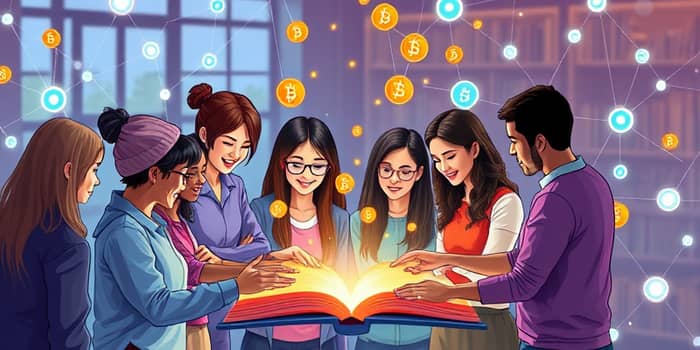
Education DAOs extend blockchain’s promise to the learning sphere by enabling token-based community voting mechanisms to steer curriculum development and resource allocation.
By aligning incentives with learning outcomes, Education DAOs foster communities that continuously co-create, refine, and disseminate educational content in real time.
The landscape of Education DAOs is illuminated by pioneering initiatives that blend ambition with practicality.
EDU DAO launched by the European Blockchain Association fosters a pan-European network of institutions committed to shared learning and rapid curriculum updates. Members engage through a token-weighted framework to propose, debate, and implement educational programs.
Tsinghua x-lab Initiative in China unites leading universities like Tsinghua, Peking, and Zhejiang. This collaborative effort creates a distributed node network that curates and distributes quality content, governed collectively by faculty and students.
Decentralized Autonomous Education (DAE) gamifies the classroom experience with Web3 mechanics. Students earn “karma” tokens for meaningful contributions, which they deploy to influence syllabus decisions, invite expert speakers, and fund collaborative projects.
MIT and Pepperdine Experiments demonstrate the power of blockchain for authenticating academic credentials. By minting diplomas as NFTs, these institutions empower graduates to own, share, and verify their achievements across digital platforms.
One of the most transformative applications is automated certification through smart contracts. Self-paced courses embed on-chain assessments that automatically evaluate student performance and issue verifiable credentials upon successful completion.
The integration of NFTs for secure and verifiable digital credentials ensures that each certificate is unique, tamper-proof, and instantly shareable with employers or institutions worldwide.
Pop-up education models, as envisioned by economist Runy Calmera, leverage DAOs to organize temporary, theme-based learning environments. These flexible cohorts dissolve upon completion, leaving behind open-source resources accessible to all.
Broader Web3 impacts include decentralized networks that connect educators and learners across continents, fostering global peer-to-peer learning networks. Smart contracts automate credit transfers and resource allocation, empowering students to chart personalized learning journeys.
Education DAOs offer democratized decision-making and collective growth that amplifies community insight and drives continuous improvement.
Despite this promise, challenges persist. The security of smart contracts hinges on rigorous code audits to prevent exploits. Additionally, token-based community voting mechanisms can concentrate power among large holders, necessitating creative governance safeguards.
Looking ahead, regulatory frameworks will play a critical role. Jurisdictions like Utah recognize DAOs as legal entities, paving the way for broader institutional adoption. As blockchain technologies evolve, innovative tools for credential verification, resource allocation, and global collaboration will emerge.
Education DAOs represent a paradigm shift in how knowledge is shared, authenticated, and governed. By harnessing blockchain's inherent strengths, they create more inclusive, agile, and resilient learning ecosystems.
As educators, learners, and innovators embrace these models, they unlock opportunities to co-create curricula, validate achievements with unparalleled trust, and forge communities united by shared purpose.
Join the movement to decentralize education and empower every individual to become both a student and a steward of collective knowledge. The future of learning is decentralized—and it starts now.
References