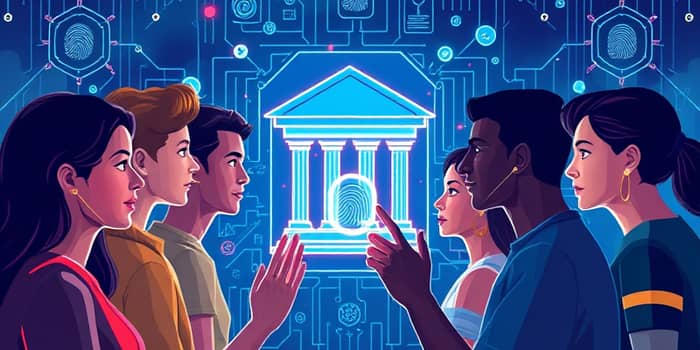
In today’s fast-evolving financial landscape, traditional passwords and PINs are no longer sufficient to safeguard our money. Banks worldwide are embracing biometric technology, turning your unique physical and behavioral traits into the ultimate security credential.
The global financial biometrics market is witnessing exponential growth. Valued around USD 9.9 billion in 2025, it’s projected to soar past USD 42 billion by 2035. Alternative forecasts estimate it will climb from USD 10.34 billion in 2026 to USD 22.24 billion by 2032 at a 13.5% CAGR, while broader systems may approach USD 100 billion by 2027.
This surge reflects a universal mandate: bolster defenses against the rapidly expanding global biometrics market and mounting cyber threats. Over 83% of banks now deploy at least one biometric method, signaling the technology’s transition from novelty to necessity.
Biometric adoption varies by region, each fueled by unique opportunities and challenges. The table below highlights key statistics and drivers shaping these trends.
Several forces converge to make biometric authentication the new standard:
By aligning these drivers with unparalleled security and convenience, financial institutions build trust and loyalty while reducing operational costs tied to fraud and support calls.
Banks today deploy a spectrum of biometric modalities, each balancing convenience, accuracy, and security:
Biometric solutions deliver multiple advantages over legacy methods:
No technology is flawless. Banks and vendors must address:
Fraud Targeting: Attackers employ deepfakes, synthetic identities, and replay attacks to spoof biometric systems.
Bias and Accuracy: Facial recognition can misidentify underrepresented groups; continuous testing and diverse datasets are essential.
Privacy Regulations: Emerging 2026 standards demand strong template encryption and user consent; non-compliance risks heavy fines.
Physiological Constraints: Fingerprint scanners require physical presence; behavioral systems must account for user variability.
The next decade promises even greater innovation:
As a user, you can take proactive steps to enhance your banking safety:
1. Enable biometric login on your mobile banking app. Strong authentication is more reliable than passwords.
2. Regularly update your device’s operating system to benefit from the latest security patches.
3. Choose banks that prioritize industry-leading biometric precision and transparent privacy policies.
4. Stay informed about emerging fraud tactics—recognizing deepfake or replay attack warnings can save your assets.
By embracing biometric authentication, you not only safeguard your finances but also enjoy a smoother, more efficient banking journey. In this era of digital transformation, your unique traits are the ultimate key to unlocking secure, frictionless financial services.
References